
The Only Thing That's Real - Part 1: The World Inside Your Head

An Essene Life Mantra
Dr. Kenn McSperitt
What if many of the things we are most certain about exist only within our own minds? In this first installment of The Only Thing That's Real series, Dr. Kenn invites readers to explore the subtle difference between reality and the mental frameworks through which we interpret it. Blending ancient wisdom with everyday observations, this Essene Life Mantra challenges us to approach life with greater curiosity, humility, and openness—revealing how personal evolution often begins not with certainty, but with the courage to question what we think we know.
I'd like to begin with something that might sound a little strange.
How many arguments have you had over something that wasn't actually real?
Now, before you answer too quickly, think about it.
Not something imaginary like dragons or unicorns.
Something you were absolutely convinced was true.
Maybe it was an argument with your spouse.
A disagreement with a coworker.
A political debate.
A theological discussion.
Maybe it was about a football team.
Or the "right" way to load the dishwasher.
Whatever it was, in that moment, you knew you were right.
And so did they.
That's fascinating to me.
Two intelligent people.
Looking at the same situation.
Reaching completely different conclusions.
How does that happen?
Well, I think it happens because most of us don't experience reality as it actually is.
We experience reality as we've learned to interpret it.
There's a difference.
If you've listened to these communions for a while, you've probably noticed that I come back to the same idea over and over again.
The world is a mirror.
We experience things as we are, not necessarily as they are.
That isn't just true emotionally.
It's true intellectually.
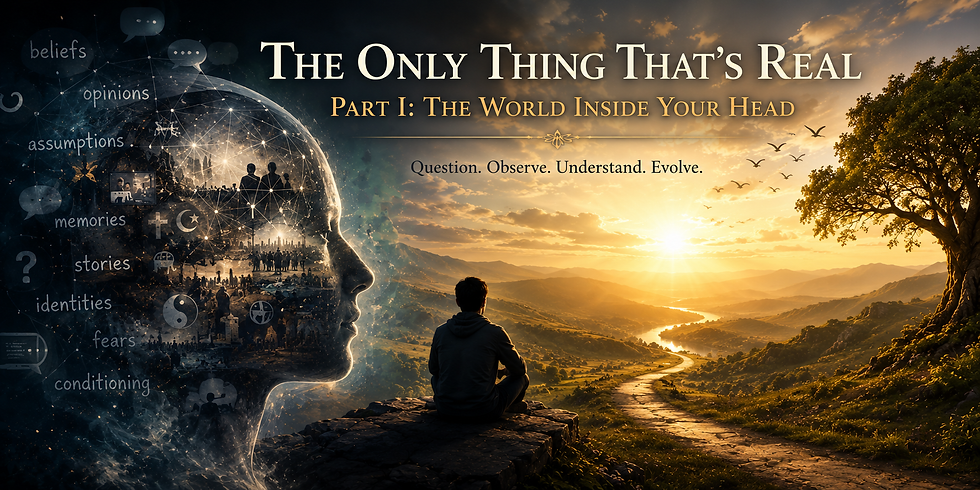
Every one of us carries around a private world inside our heads.
It's filled with memories.
Experiences.
Opinions.
Assumptions.
Stories we've told ourselves.
Stories other people told us.
Things we've never questioned because they simply became part of who we are.
And little by little, we begin mistaking that private world...
for reality itself.
Have you ever noticed how certain we can become?
I certainly have.
Sometimes I laugh at myself.
I remember opinions I held twenty years ago that I would have defended with everything I had.
Today?
I don't believe half of them anymore.
Have you had that experience?
Maybe not twenty years.
Maybe five.
Maybe one.
You look back and think,
"I can't believe I used to think that."
What changed?
Reality?
Usually not.
You changed.
Your experiences changed.
Your understanding changed.
Your perspective changed.
That should make us humble.
Because if we've been wrong before...
might we be wrong again?
I honestly think one of the characteristics of wisdom is becoming comfortable saying three little words.
"I don't know."
Not because we know nothing.
But because we've learned how much there is still to discover.
One of the things I admire most about truly wise people is that they aren't trying to win every conversation.
They're trying to understand.
They ask questions.
They listen.
They're curious.
They leave room for mystery.
Contrast that with someone who's absolutely certain about everything.
Have you ever tried changing their mind?
It's nearly impossible.
Not because they're necessarily right.
Because certainty closes doors.
Curiosity opens them.
Now here's where this becomes interesting.
According to the founders of many of the ancient peace traditions, most of what fills our minds belongs to the realm of imagination.
Now don't misunderstand that word.
I'm not talking about fantasy.
I'm talking about the mental frameworks we build to make sense of life.
Another word for them is beliefs.
We all have them.
They help us function.
They help us organize the overwhelming amount of information we encounter every day.
Without them, we'd probably struggle just to get through the grocery store.
So beliefs aren't the enemy.
They're useful.
The problem comes when we forget they're maps...
and begin treating them as the territory.
Think about a road map.
It's incredibly valuable.
But no one would confuse the map with the landscape itself.
The map points toward reality.
It isn't reality.
Our beliefs work much the same way.
They help us navigate.
But they aren't the destination.
They're interpretations.
And interpretations can change.
In fact, they should.
That's what learning is.
That's what growth is.
That's what personal evolution is.
If you've never changed your mind about anything...
you probably haven't learned very much.
I know that sounds blunt.
But I think it's true.
Every major season of growth in my own life began with one realization.
"Maybe I don't see this as clearly as I thought I did."
That realization isn't weakness.
It's the doorway to wisdom.
The older I get, the less interested I am in being right.
I'm much more interested in seeing clearly.
Those aren't always the same thing.
One protects the ego.
The other expands consciousness.
And if personal evolution is really the purpose of our lives—as I believe it is—then seeing more clearly becomes one of the greatest gifts we can give ourselves.
Next time, I'd like to explore something that naturally follows from this.
If our beliefs are ways of interpreting reality...
what happens when we begin confusing those beliefs with reality itself?
Because that may explain many of the divisions we see in our families...
our communities...
our nations...
and even within ourselves.
Dr. Kenn Challenge
Until we meet again, every time you catch yourself saying,
"I know..."
pause for just a moment.
Replace it with:
"From my experience, it seems..."
Notice what happens.
Notice whether your conversations become more open.
Notice whether you become more curious.
Notice whether certainty begins giving way to understanding.

You may discover that wisdom doesn't begin with having all the answers.
It begins with asking better questions.
These are the teachings of the Ancients.
Timeless in origin.
Endless in application.
Dr. Kenn
Discover more articles, essays, and mantras like this at:


Comments