
Belief, Part 3: Beyond Belief

An Essene Life Mantra
Dr. Kenn McSperitt
What if belief was never meant to be the destination? In the concluding installment of the Belief series, Dr. Kenn explores the relationship between faith, direct experience, and personal transformation, inviting readers to look beyond inherited certainty toward a deeper, lived understanding of truth. Drawing upon ancient peace traditions, Nature, and the journey of personal evolution, this Essene Life Mantra offers a fresh perspective on spirituality—one that encourages participation, discovery, and the quiet wisdom that can only be found through experience.
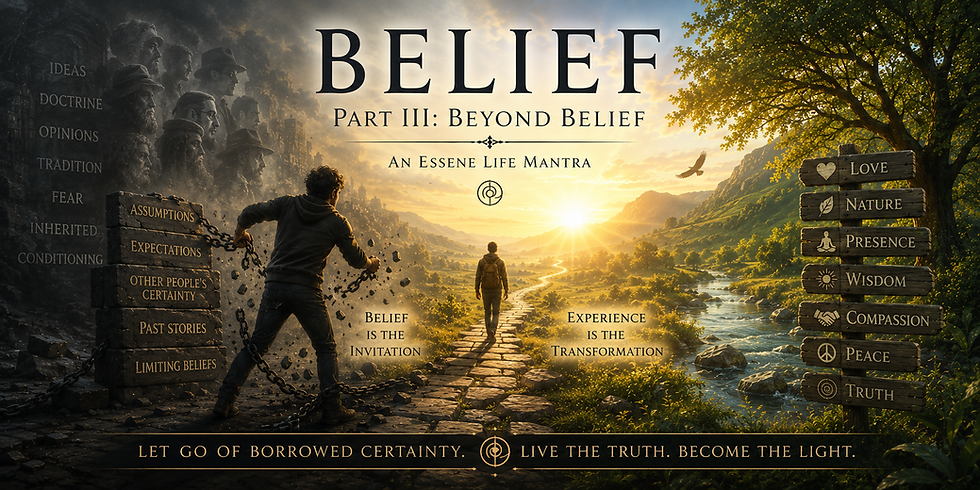
Over the last couple of weeks we've spent a lot of time talking about belief. Why we believe. Where our beliefs come from. How many of them we've inherited without ever really examining them. Tonight I'd like to ask one final question. What if belief was never meant to be the destination?
Think about that for a minute.
Suppose someone spent their entire life reading books about swimming. Every technique. Every stroke. Every scientific paper. Every historical account. They could probably tell you more about swimming than most Olympic coaches. But if they never stepped into the water---would they actually know how to swim?
Of course not.
Knowledge isn't experience. The map isn't the landscape. The recipe isn't the meal. Reading about music isn't the same as hearing it. Thinking about love isn't the same as loving someone. And reading about peace---isn't the same as living peacefully.
It seems obvious when we say it that way. Yet somehow we often treat spirituality differently. We believe that believing is enough. That agreeing with certain ideas somehow transforms us. I'm not convinced that's how life works.
If you've been with me through these Evening Communions, you've probably noticed something. I don't spend much time asking people what they believe. I'm much more interested in how they're living. Because eventually---life tells the truth.
A person may tell me they believe in compassion. Wonderful. Do they practice it? Someone may say they believe in forgiveness. Beautiful. Have they forgiven? Someone may tell me they believe in peace. I hope so. Are they becoming more peaceful?
That's where things become real.
I've often thought about the wonder of honey. You can read an entire library about honey. Its chemistry. Its history. Its nutritional value. The flowers the bees visit. You can memorize every fact ever written about it. But none of that tells you what honey tastes like. For that---you have to taste it. To experience it directly.
Life is full of honey. Love is honey. Forgiveness is honey. Gratitude is honey. Stillness is honey. Nature is honey. You can believe in all of those things. Or---you can experience them. Those are two very different ways of living. One depends upon a concept. The other depends upon an encounter. And that's where I think many of us get stuck.
We're taught to believe before we've learned to observe. To memorize before we've learned to experience. To defend before we've learned to understand. Somewhere along the way, belief quietly replaced discovery. I don't think that was ever the intention.
One of the things I've always admired about Nature is that it never asks for your belief. The sunrise doesn't require your agreement. Gravity doesn't need your faith. The wind doesn't wait for your approval. Nature simply invites your participation.
Walk outside. Feel the warmth of the sun. Take a deep breath. Stand barefoot on the Earth. No belief required. Only experience. Maybe the deepest spiritual truths are more like that. Maybe they don't require us to believe quite so much as they invite us to participate.
I've often described The Path of Peace as an experiment. Not because I'm uncertain about it. Because I don't want you taking my word for anything. Try it. Practice intentional thought. See what happens. Practice compassion. Notice what changes. Spend more time in Nature. Observe your body. Your emotions. Your mind. Don't believe me. Experience it. If it produces greater health---greater peace---greater wisdom---greater joy---then you've learned something no one can ever take away from you. Not because I told you. Because you've lived it.
That kind of knowing is different. It's quieter. More stable. It doesn't need to argue. It doesn't need to convince. It simply becomes part of who you are. And perhaps that's what the founders of the ancient peace traditions were trying to tell us all along. Truth isn't merely something to believe. Truth is something to become. That's a very different way of living. And I think---it's a much more beautiful one.
You know, there's a word that I've been hesitant to use in conversation. Not because I don't like it. But, because I know what happens the moment people hear it. The word is---anarchy.
The moment most people hear that word, they picture burning buildings. Chaos. Lawlessness. People doing whatever they want without consequence. That's the picture our culture has painted. But words have histories. And sometimes those histories get buried beneath misunderstanding.
At its simplest, anarchy means self-rule. Self-governance. The absence of someone else ruling over your conscience.
Now, before anyone misunderstands me---I'm not talking about overthrowing governments. I'm not talking about ignoring laws. I'm talking about something much more personal. Who governs your life? Really. When you make a decision---who's making it? Is it fear? Habit? Social pressure? The expectations of your family? Your political tribe? Your religious tradition? Your favorite influencer? Or is it you?
That's a much harder question than it first appears. Because if we're honest, many of us spend a surprising amount of our lives allowing other people to think for us. Not intentionally. Gradually. Quietly. Almost without noticing.
We begin adopting opinions because the people we admire hold them. We repeat ideas because they're familiar. We defend positions we've never personally examined. Not because we've discovered them. Because we've inherited them.
I've been guilty of that.
I imagine you have too.
The beautiful thing about personal evolution is that eventually life begins asking us a different question. Not, "What have you been told?" But, "What have you discovered?"
There's a tremendous difference.
One belongs to authority. The other belongs to experience. One depends upon someone else's certainty. The other grows from your own observation.
That's what I've come to mean by Spiritual Anarchy.
Not rebellion. Responsibility. The willingness to stand before the Source without hiding behind someone else's conclusions. To say, "I want to know You through experience, not merely through description."
That takes courage. Because experience asks more of us than belief. Belief can remain comfortably theoretical. Experience changes us. I've often said that The Path of Peace is experimental. It asks you to test ideas. To observe their fruit. To become a scientist of your own consciousness. Notice what increases peace and what decreases it. Notice what strengthens your body and what weakens it. Notice what opens your heart and what closes it.
Nature has been doing this for billions of years. Every living thing continually adjusts to reality. Only human beings seem determined to defend ideas that reality itself has outgrown. Maybe that's because changing our minds feels like losing something. But perhaps we're not losing anything at all. Perhaps we're simply making room for something truer.
One of the reasons I spend so much time talking about personal evolution is because I don't believe the Source desires followers nearly as much as participants.
Think about that.
Parents don't ultimately want children who obey forever. Healthy parents want children who mature. Who develop wisdom. Who become capable of governing themselves.
Why would the Source desire anything less?
Perhaps spiritual maturity isn't measured by how many beliefs we've collected. Perhaps it's measured by how responsibly we exercise our freedom. That's what self-governance really is. Not doing whatever we want. Wanting what is wise. Not freedom from responsibility. Freedom through responsibility. To me, that's a far more beautiful vision of spirituality than one built upon fear. Because it treats every one of us as capable of growth. Capable of discernment. Capable of direct relationship with the Source. No intermediary required. No borrowed certainty required. Just a human being---standing honestly before life---learning---growing---becoming.
And maybe that's what freedom has always meant. Not escaping authority. But becoming the kind of person who no longer needs someone else to tell them how to love.
If you've been with me through this entire series---you've probably noticed something. I haven't been trying to convince you not to believe. That was never the point. Belief has its place. In fact, I think belief can be a beautiful beginning. The question is---does it remain the beginning? Or does it become the destination?
Because I don't think the Source is asking us to spend our lives believing. I think the Source is inviting us to spend our lives becoming. There's a world of difference.
You see, belief says, "I think this is true."
Experience says, "I have lived this."
Belief says, "I've heard about peace."
Experience says, "I've become more peaceful."
Belief says, "I've read about forgiveness."
Experience says, "I've forgiven someone who hurt me."
Belief says, "Nature heals."
Experience says, "I've spent enough time in Nature to know it changes me."
One depends upon someone else's testimony. The other becomes your own. That's why I believe the founders of the ancient peace traditions spent so much time in deserts---mountains---forests---rivers---and caves. Not because those places were magical. Because they were quiet enough for experience to replace opinion.
The river doesn't ask you to believe in flow. It invites you to watch.
The sunrise doesn't ask for your agreement. It simply appears.
The wind doesn't argue. The Earth doesn't preach.
Nature doesn't persuade. Nature demonstrates.
Maybe that's why I've come to trust Nature so deeply.
Not because it's perfect. Because it's honest.
It doesn't ask me to suspend my reason. It asks me to participate.
And perhaps the Source works much the same way.
Maybe the Source has never demanded blind belief.
Maybe we've demanded that of one another.
Maybe the Source has always been saying,
"Come and see."
"Come and experience."
"Come and become."
That changes everything.
Because now spirituality is no longer about collecting the correct ideas. It's about cultivating the correct life.
I've often said that peace is health. Health of body. Health of emotion. Health of mind. Those aren't beliefs. They're experiences. You either become healthier---or you don't. You become more compassionate---or you don't. You become more patient---or you don't.
Personal evolution isn't measured by what you can recite. It's measured by what you've become. And maybe that's the greatest freedom of all. You no longer have to defend every belief. You no longer have to convince everyone else that your map is the best map. You simply walk the path. You become the evidence.
I've noticed something about people whose lives genuinely inspire me. They rarely spend much time telling me they're wise. Or peaceful. Or loving. They don't have to. Their lives quietly communicate it. Their presence communicates it. The fruit speaks before the words ever do.
Perhaps that's what communion with the Source really looks like. Not escaping the world. Not withdrawing from life. But becoming so deeply aligned with truth, wisdom, compassion, peace, and love that those qualities begin radiating naturally into everything you do. Not because you're trying to impress anyone. Because that's who you're becoming.
I've spent a great deal of time talking about The Path of Peace. Some people think it's another philosophy. Another belief system. I don't. I think it's an invitation. An invitation to experiment. To observe. To participate. To discover. To experience directly the things we've spent thousands of years arguing about.
Because I suspect something beautiful happens when experience replaces ideology. Arguments begin to soften. Judgment begins to fade. Curiosity returns. Wonder returns. Humility returns. And somewhere along the way---belief quietly transforms into knowing. Not the kind of knowing that becomes arrogant. The kind that becomes grateful.
I think that's where this whole journey has been leading us. Not toward more beliefs. Toward more life. Toward more peace. Toward more wisdom. Toward more love. Toward greater communion with the Source through the extraordinary privilege of being fully present---fully awake---and fully alive.
Dr. Kenn Challenge
Until we meet again, I'd like you to try a simple experiment.
Choose one thing you've always believed to be true. Not because someone told you. Because you've accepted it. Then, for the next seven days, don't try to defend it. Don't try to prove it. Instead, ask yourself: "How can I experience this directly?"
If it's kindness---practice kindness.
If it's peace---practice peace.
If it's gratitude---practice gratitude.
If it's forgiveness---forgive.

Move one belief from concept---to experience.
Because beliefs may point the way.
But experience walks the path.
These are the teachings of the Ancients.
Timeless in origin.
Endless in application.
Dr. Kenn
Discover more articles, essays, and mantras like this at:


Comments